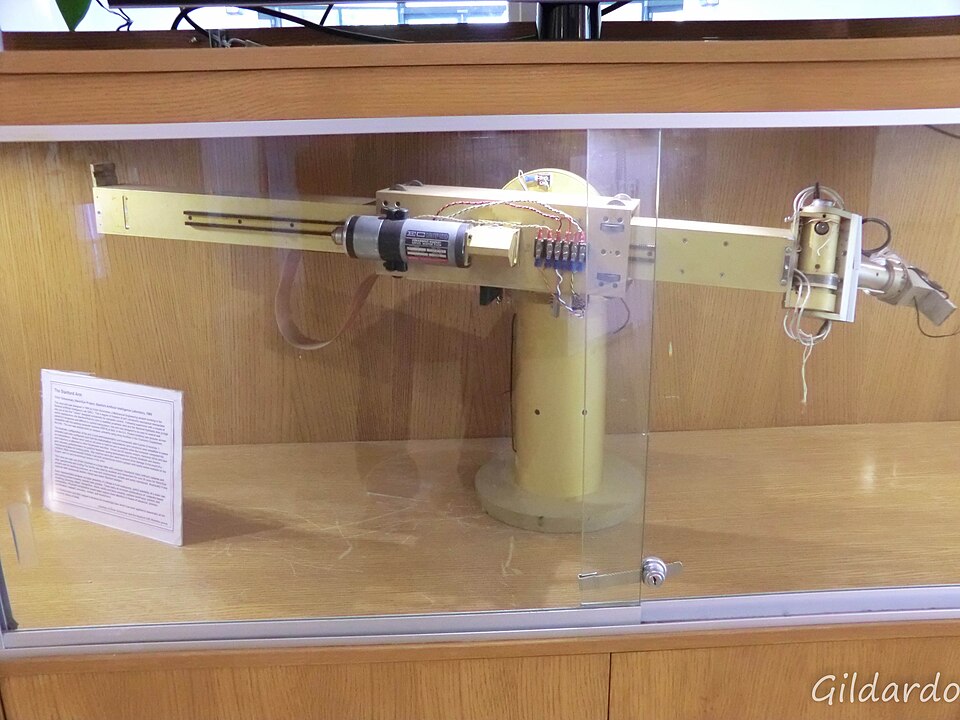
Stanford Arm
1969Victor Scheinman / Stanford
Robotic ArmElectricComputer-ControlledResearch
The Stanford Arm was the first all-electric, computer-controlled robot arm. Designed by Victor Scheinman as a graduate student, it had six degrees of freedom and could follow arbitrary paths in 3D space under computer control. Unlike hydraulic industrial arms, it was precise, programmable, and affordable enough for research labs. The design directly influenced the PUMA (Programmable Universal Machine for Assembly) industrial robot, which became the workhorse of factory automation in the 1980s. Scheinman later founded companies to commercialize his designs, and the architecture of articulated robot arms used today traces directly back to his Stanford work.
Relevance for Infinite Machine
The Stanford Arm showed that electric actuation (not hydraulic) was the future of precision robotics — a principle Boston Dynamics recently validated by switching Atlas from hydraulics to electric.