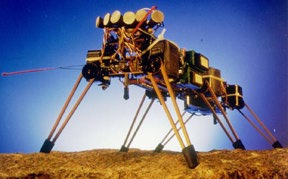
Genghis
1989Rodney Brooks / MIT
HexapodBehavior-BasedResearchSubsumption
Genghis was a six-legged walking robot built at MIT's AI Lab by Rodney Brooks. At just 35 centimeters long and 1 kilogram, it was small but revolutionary. Genghis used Brooks' "subsumption architecture" — a radical departure from traditional AI. Instead of building a complex world model and planning actions, Genghis layered simple reactive behaviors: stand up, walk forward, follow a heat source, avoid obstacles. These behaviors ran in parallel, with higher layers overriding lower ones when needed. The result was robust, adaptive locomotion that emerged from simple rules. Brooks' approach influenced iRobot (which he co-founded) and shaped modern thinking about embodied AI.
Relevance for Infinite Machine
Genghis proved that you don't need sophisticated AI to create useful locomotion — reactive behaviors are enough. This principle applies to early-stage autonomous systems: start with simple, robust behaviors and layer complexity over time.